Music and Medicine Vol 18, No 2: Editorial Feature and Table of Contents
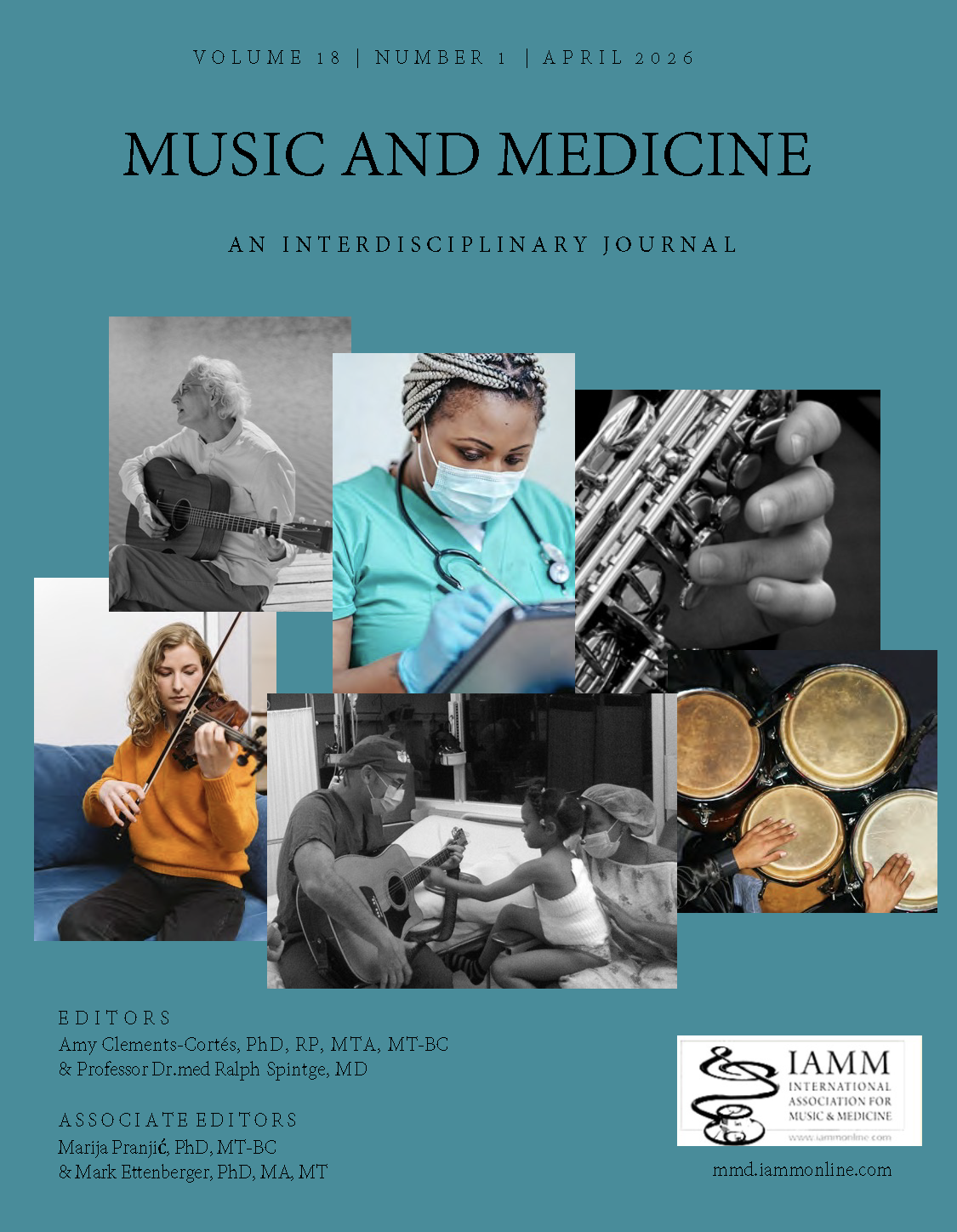
Table of Contents
Editorial
Expanding Access, Strengthening Practice
Amy Clements-Cortés, Ralph Spintge
Full Length Articles
The PERMA-based group music therapy: An intervention protocol for enhancing well-being in adults (Open Access)
Bing Wang, Wendy L. Magee
The brain symphony for post-stroke rehabilitation: A pilot randomized controlled study with P. Ramlee songs
Wen Fen Beh, Lydia Abdul Latif, Nasir Bin Hashim, Tze Yang Chung
The Efficacy of the Bonny Method of Guided Imagery and Music in Pain Management for Patients with Rheumatoid Arthritis: A Randomized Controlled Study
georgia nika
Enhancing Diagnostic Accuracy and Management of Major Depressive Disorders via Tailored Musical Interventions and Neuro-acoustic Stimulation: Music and Neuro-acoustics in MDD Treatment
Dr Shahzad Aasim, Dr Rakesh Banal, Dr Muheet Butt, Dr Sanjeev Rana, Dr Hilal Ahmad Wani, Dr Suhail Ahmad
Review: Pharmacological interventions and Music Therapy in the management of Autism Spectrum Disorder in Children
George Charonitis, Phd
Feature: The PERMA-based group music therapy: An intervention protocol for enhancing well-being in adults
Bing Wang, Wendy Magee
Abstract
In recent years, mental health promotion has increasingly focused not only on treating illness but also on fostering well-being at both individual and community levels. However, a theoretical framework is lacking to guide protocol development. The PERMA model, proposed by Seligman, conceptualizes well-being through five core elements: Positive Emotion, Engagement, Relationships, Meaning, and Accomplishment. The purpose of this paper is to present a detailed group music therapy intervention protocol based on the PERMA model. We offer a protocol for an eight-session group music therapy intervention designed around the PERMA principles, incorporating music listening, movement, and improvisation to support participants’well-being. The program begins with an introductory session to establish group connections, followed by six sessions dedicated to exploring the PERMA elements through music-based experiences, and concludes with a final session to reflect and consolidate progress. By offering a structured yet adaptable framework, this music intervention serves as both a proactive approach to mental health and a practical resource for music therapists. The protocol serves as an approach for testing in a forthcoming trial.

Bing Wang, PhD, is a music therapist and associate professor at Minzu University of China in Beijing, China. She received her PhD in Music Therapy from Temple University, USA, and is a Fellow of the Association for Music and Imagery (AMI). Her research interests include group music therapy, well-being promotion, positive psychology, and community-based music interventions.

Wendy L. Magee, PhD, is Professor of Music Therapy at Temple University, Philadelphia, USA and coordinator of the PhD program. Dr. Magee’s primary research centers on evidence-based interventions for individuals with Disorders of Consciousness. In 2023 she received the World Federation of Music Therapy Research Award and is a board member of the International Association of Music and Medicine.
Interview with Dr. Bing Wang
- Can you provide an overview of the article and the topics it explores?
This study was my dissertation research. This article introduces a PERMA-based group music therapy program developed to support well-being in healthy adults. Inspired by Seligman’s PERMA model of positive psychology, the intervention integrates the five dimensions of well-being—Positive Emotion, Engagement, Relationships, Meaning, and Accomplishment—into group music therapy experiences.
The paper describes an eight-session program that combines music listening, movement, improvisation, group music-making, and reflection. Instead of focusing primarily on problems or symptoms, the intervention aims to help participants strengthen positive emotional experiences, social connection, creativity, and personal resources through shared musical experiences.
In addition to presenting the structure of the program, the article also explores how music therapy and positive psychology can be meaningfully integrated in practice. We hope this protocol can offer a practical framework for music therapists and encourage further work in the area of well-being promotion and preventive mental health care.
2. What inspired you to undertake this particular study?
This study was deeply inspired by my long-term clinical and teaching experiences with both college students and special needs populations in China. Since 2003, I have worked in music therapy settings in Beijing, and over the years I became increasingly aware that music could offer much more than symptom reduction—it could also help people experience connection, vitality, meaning, and hope.
While teaching at Minzu University of China, I facilitated individual and group music therapy experiences for college students and later developed a music therapy-based course focused on mental well-being. Through songwriting, music improvisation, music and imagery, movement, and group sharing, I observed that students often felt emotionally supported, more authentic, and more connected with one another. Many students described the class as one of the few spaces where they could truly relax and express themselves freely. Their responses made me begin thinking more seriously about how music therapy might contribute to well-being promotion in the general population, not only in clinical settings.
Another important influence came from my work with adolescents with autism and other special needs populations. Since 2013, I have led inclusive group music therapy projects involving music therapy students, college volunteers, and special needs participants. Through shared musical experiences such as singing, drumming, musical games, and performances, I witnessed meaningful changes in emotional expression, social interaction, and group connection. These experiences gradually shifted my perspective from a primarily problem-focused approach toward a more resource-oriented way of working that emphasizes strengths, positive experiences, creativity, belonging, and human potential.
During my time as a visiting scholar at Tsinghua University, I was introduced to positive psychology and Seligman’s PERMA model. I immediately felt a strong connection between the PERMA framework and what I had already been observing in music therapy practice. Music naturally seemed to support positive emotion, engagement, relationships, meaning, and accomplishment. This realization inspired me to begin exploring how a structured music therapy intervention could intentionally cultivate these dimensions of well-being.
Together, these experiences motivated me to develop a PERMA-based group music therapy protocol that could support not only mental health prevention, but also flourishing, connection, and well-being across broader populations.
3. What future research or areas of exploration would benefit the field and application of what was discussed in this article?
As this article presents a structured PERMA-based group music therapy intervention protocol, future research could further explore how this framework may be adapted and applied across different populations and settings. Although the protocol was originally developed with young well-adults in mind, it may also be valuable to explore its use with adolescents, older adults, and broader community populations.
It would also be meaningful to examine the longer-term impact of PERMA-based group music therapy through follow-up studies and larger participant samples. In addition, I hope future work continues exploring how music therapy can contribute not only to treatment, but also to preventive mental health care and well-being promotion in healthcare and community settings.
4. How do you think this article impacts the current understanding of music and medicine?
I hope this article contributes to the growing understanding that music therapy can play an important role not only in clinical treatment, but also in well-being promotion and preventive mental health care. In many healthcare contexts, music-based interventions are still primarily associated with symptom reduction or rehabilitation. This protocol highlights another important perspective: supporting positive human experiences such as connection, engagement, meaning, and emotional vitality.
I also hope the article helps strengthen the dialogue between music therapy, positive psychology, and broader healthcare practices by offering a structured and theory-informed framework for music-based well-being interventions. By grounding the intervention in the PERMA model, the protocol may provide a clearer language for discussing how musical experiences can contribute to mental health and flourishing.
More broadly, I believe this work reflects an increasing movement within music and medicine toward resource-oriented and preventive approaches that support quality of life, resilience, and human connection across both clinical and non-clinical populations.
5. In your opinion, what are the most significant implications of your findings for the field of music therapy and its integration into healthcare practices?
One important implication of this work is that music therapy may have a meaningful role not only in clinical treatment, but also in preventive mental health care and well-being promotion. As healthcare systems increasingly recognize the importance of emotional well-being, social connection, and quality of life, music therapy may offer accessible and engaging ways to support these areas through shared musical experiences.
I also believe this work highlights the value of resource-oriented and group-based approaches in music therapy. Rather than focusing only on problems or symptoms, the protocol emphasizes strengths, creativity, connection, meaning, and positive human experiences. This perspective may help broaden how music therapy is understood within healthcare and community settings.
In addition, presenting a structured and theory-informed intervention protocol may help support communication between music therapists and other healthcare professionals. I hope this kind of framework can contribute to greater interdisciplinary collaboration and encourage the inclusion of music therapy within broader well-being and healthcare initiatives.


0 Comments